Self-belief.
The belief that something can be learned, even when it cannot be done yet. Explore ways to make progress visible.

For the parent hearing “I can’t do it”
Let them see what trying again looks like.
The Success Child by Marcus Fenley explores how everyday moments of watching a parent meet a challenge can help shape a child’s approach to difficulty. Discover the Mirror Method — and a practical plan for bringing it into family life.
Kindle · Paperback · Hardcover
Available on Amazon · For parents of children ages 2–12

A familiar moment
A puzzle piece will not fit. A math problem looks too hard. Before another attempt, the task has become a judgment: I can’t do it.
You want to encourage your child. But saying “You’re clever” or stepping in to finish the task may leave the harder question untouched: what does struggling mean to them?
This book invites you to look at the examples they see. How you talk about your own mistakes. How you ask for help. What you do when your first attempt does not work.
The three pillars
The book separates three capacities that are often grouped together — so you can look more closely at the kind of support your child needs.
The belief that something can be learned, even when it cannot be done yet. Explore ways to make progress visible.
The willingness to begin when the outcome is uncertain. Read about taking a first step without needing to feel ready.
What happens after an attempt goes wrong. Explore making room for frustration and finding a way back to the task.
The Mirror Method brings these ideas into ordinary family moments: your child gets to see the effort, the mistakes, and the next attempt.
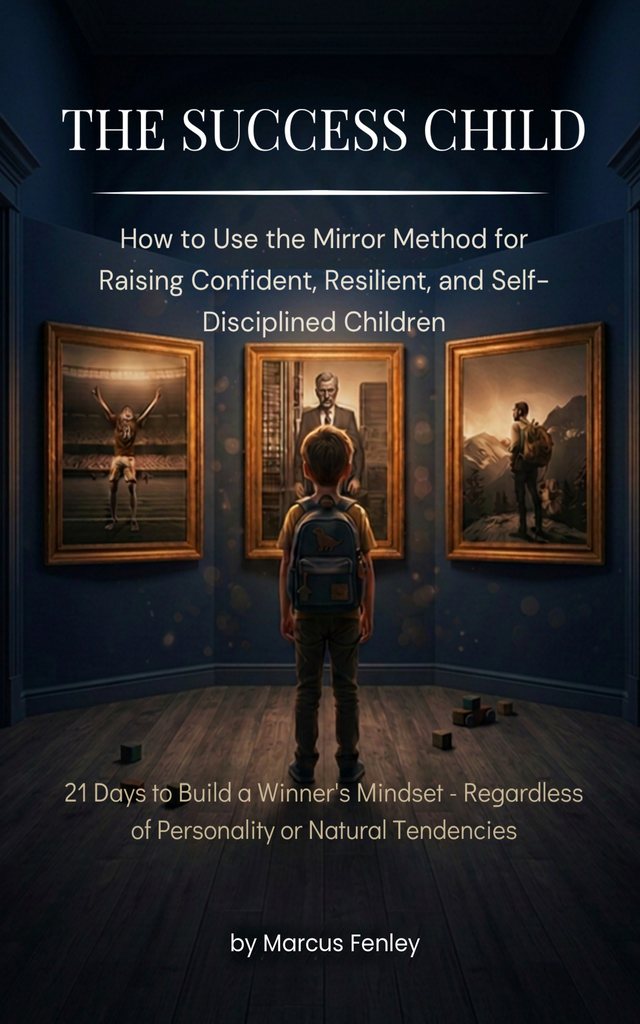
The Parent Leader Series · Book 1
How to Use the Mirror Method for
Raising Confident, Resilient, and Self-Disciplined Children
A practical parenting guide about the small examples children collect from daily life — and how to make those examples more useful.
From the introduction
“A friend of mine overheard her daughter talking to a jigsaw puzzle. The girl was six. She had the edge pieces down and had got stuck on a stretch of sky, and she said, quietly, to nobody, I am just not clever enough for this.”
Marcus Fenley · The Success Child
The opening story leads to a question that runs through the book: what do children learn from watching how we handle our own difficulties?
Continue with the full bookA structure for practice
The program gives you a sequence for putting the ideas into practice: a winner’s mentality, courage and initiative, resilience to failure, and finishing what you start.
Twenty-one days is a structure, not a deadline for change. The introduction explicitly explains that habits take longer and develop at different rates. “Day Twenty-Two” then looks at what comes next.
The aim is to bring small examples into everyday life — and have a way to return to them when things slip.
A look inside
Four parts, 18 chapters, a conclusion, quick reference, and glossary.
Is this your next read?
Written primarily for parents of children ages 2–12, this book explores giving up early, avoiding new challenges, and struggling to return after a mistake.
It asks you to notice your own habits and make your learning more visible. You do not need to perform perfect confidence or turn every activity into a lesson.
The focus is a child’s relationship with difficulty, rather than grades, trophies, or comparison with other children.
Take the next step
Explore the full Mirror Method and the practice plan in the edition that suits you.
Digital edition
Read on a Kindle device or in the Kindle app.
Buy Kindle on AmazonPrint edition
A print copy to read, mark up, and return to.
Buy Paperback on AmazonPrint edition
A hardcover edition for your bookshelf.
Buy Hardcover on AmazonEach button opens Amazon.com in a new tab. Check Amazon for current pricing, availability, and delivery details. Purchases are completed on Amazon.
Before you choose
The book focuses on self-belief, courage, and resilience: how children approach learning, uncertainty, and mistakes. Its introduction explicitly says that your child is not a project and you are not being graded.
There is no guaranteed timetable. The author describes twenty-one days as a manageable structure for practice, not a claim that habits form in three weeks. Later chapters cover maintaining the approach and returning after setbacks.
The book makes room for imperfect examples and repair. It includes chapters on your own responses, what to do when things slip, and the beliefs you brought into parenting.
The main audience is parents of children roughly ages 2–12. The introduction discusses adapting the ideas for older children with more collaboration and less structure.
The digital edition is available on Amazon as a Kindle book. This website does not currently sell or provide PDF or EPUB downloads.
You do not have to get it right every time.
Let them see you try again.