Digital edition
Kindle
Read on a Kindle device or in the Kindle app.
Buy Kindle on Amazon
For the parent carrying every deadline
Help your teenager take ownership of the next step.
Not Your Homework by Marcus Fenley explores how parents come to manage a teenager’s school life — and how the five-stage Handover Method can help them begin giving that responsibility back.
Kindle · Paperback
Available on Amazon · For parents of teenagers ages 12–18

The plan you made for them
The plan is sensible. There is time for every subject. You even worked around soccer practice. Your teenager says it looks fine.
A week later, one box is checked. You are the one wondering what happened.
Who is doing the work of remembering, noticing, and planning? This book starts with that question. It examines how a parent can become the person running the school week, then explores how to help a teenager take a more active part in running it.
Inside the Handover Method
Five stages, developed in order. Start by seeing what you carry before changing how you help.
Deadlines, reminders, checking, arranging help: identify the tasks that have quietly become yours.
A teenager cannot take ownership of responsibilities that remain inside a parent’s head. Explore how to make that hidden work visible.
Read about choosing low-stakes opportunities to learn from what happens, with attention to the difference between a recoverable setback and a cost that is too high.
Move toward advising and discussing, while your teenager does more of the deciding and organizing.
Explore the difficult part of stepping back: allowing your teenager to carry out the work without constant monitoring.
The following chapter brings the stages together in a study plan your teenager writes themselves. The book asks readers to allow time for practice, rather than expect a quick change in grades.
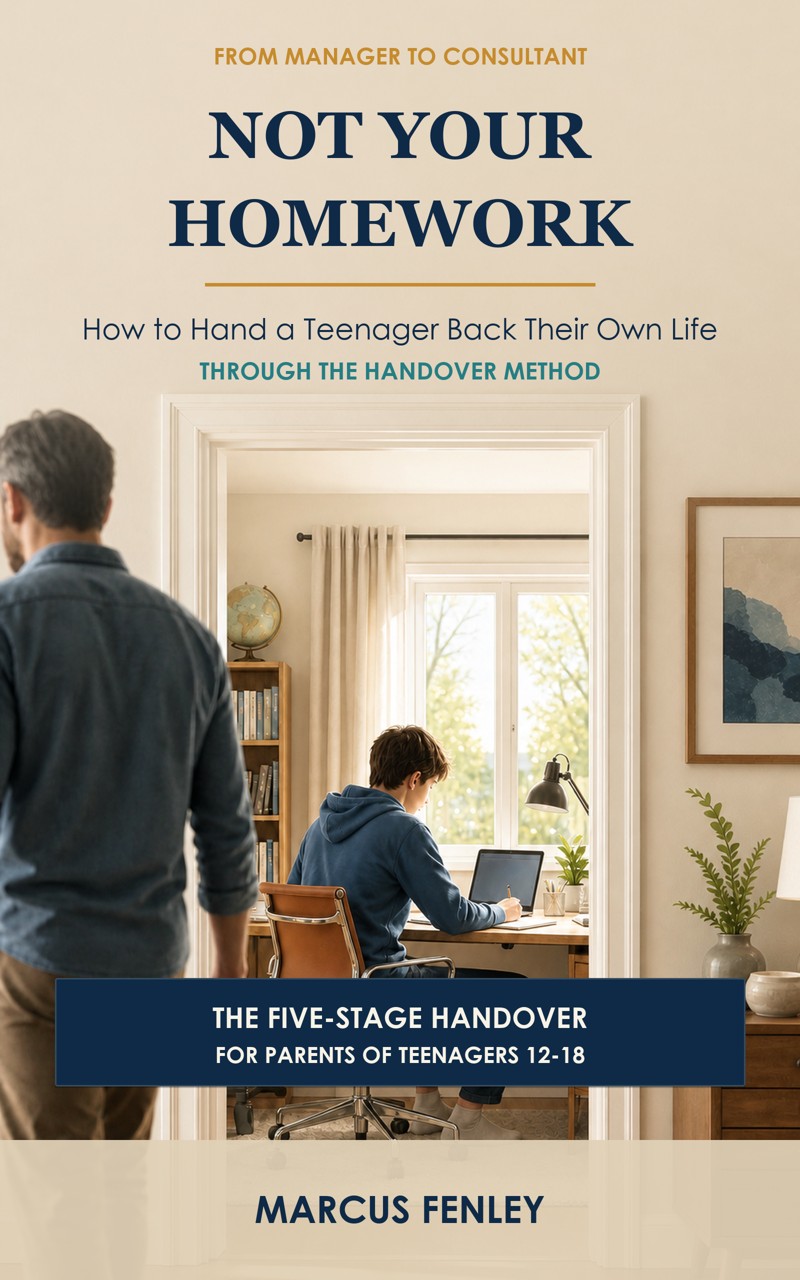
The Parent Leader Series
How to Hand a Teenager Back Their Own Life,
Through the Handover Method
A practical guide to the part of a teenager’s school life a parent can change: their own role in it.
From the introduction
“I want to look closely at that timetable, because it is the whole book. Not because it was a bad timetable. Because of who made it.”
Marcus Fenley · Not Your Homework
The opening scene asks you to look past the quality of the plan and notice who owns it.
Continue with the full book →A look inside
Four parts, 19 chapters, followed by a conclusion, quick reference, and glossary.
Is this your next read?
Written for parents of teenagers ages 12–18 who find themselves tracking schoolwork, making the plans, and initiating most of the conversations about what is due.
Fenley writes from personal experience. The book focuses on changing your role, with practical chapters to return to as your family works through the handover.
If you are concerned about your teenager’s mood, learning, or wellbeing, seek support from their school or a qualified professional. Chapter 16 explores why a difficulty may need more than a change in motivation.
Take the next step
Read the full Handover Method in the edition that suits you.
Digital edition
Read on a Kindle device or in the Kindle app.
Buy Kindle on AmazonPrint edition
A print copy to read, mark up, and return to.
Buy Paperback on AmazonEach button opens Amazon.com in a new tab. Check Amazon for current pricing, availability, and delivery details. Purchases are completed on Amazon.
Before you choose
Parents of teenagers ages 12–18. The book discusses both the earlier years, when there is more room to practice, and the final school years, when the approach needs to be more collaborative and explicit.
The method starts with an audit and making responsibilities visible, then develops the shift from manager to consultant. Read the stages in order so that stepping back is part of a considered handover.
The book offers no guarantee of better grades. It focuses on who initiates, plans, and takes responsibility; it also discusses the setbacks that can happen during that transfer.
Chapter 16 addresses that question. The book is educational guidance and does not replace professional medical, psychological, or educational assessment.
The links above lead to the Kindle and paperback editions on Amazon. Kindle books can be read on a Kindle device or in the Kindle app.
You can stay available.
They can take the next step.