Shrink the first move.
Look for one physical action that starts the task, rather than presenting the whole job at once.

For the parent doing all the reminding
Start by looking at what makes the first move difficult.
In a Minute by Marcus Fenley explores the gap between knowing what to do and actually starting. Discover five kinds of delay — and the First Move Method for helping your child begin with less prompting.
Kindle · Paperback · Hardcover
Available on Amazon · For parents of children ages 5–12

A familiar morning
You have asked. They have answered. But the blocks are still in their hands, the shoes are still by the door, and you are watching the clock.
By the fourth reminder, your voice sounds different. A small task has become another tense start to the day.
This book asks you to examine the moment before action. What is keeping your child from beginning? And how can you help without becoming the person who starts every task for them?
A different place to look
The book describes five patterns that can sound the same from the doorway. Understanding the pattern helps you choose a response.
Your child is caught up in what they are already doing. This chapter explores the transition from that activity to the next one.
The task feels too large or its first step is unclear. Explore how a smaller, concrete beginning can change the request.
The delay is part of a familiar exchange over what will happen. This chapter looks at the pattern of negotiation.
Starting may mean facing something uncomfortable. Read about noticing what is behind the hesitation.
This chapter explores a different kind of delay: the child who has little left to give, rather than an activity they will not leave.
These are the author’s practical descriptions, not diagnostic categories. The book also addresses situations that need support beyond changing a household routine.
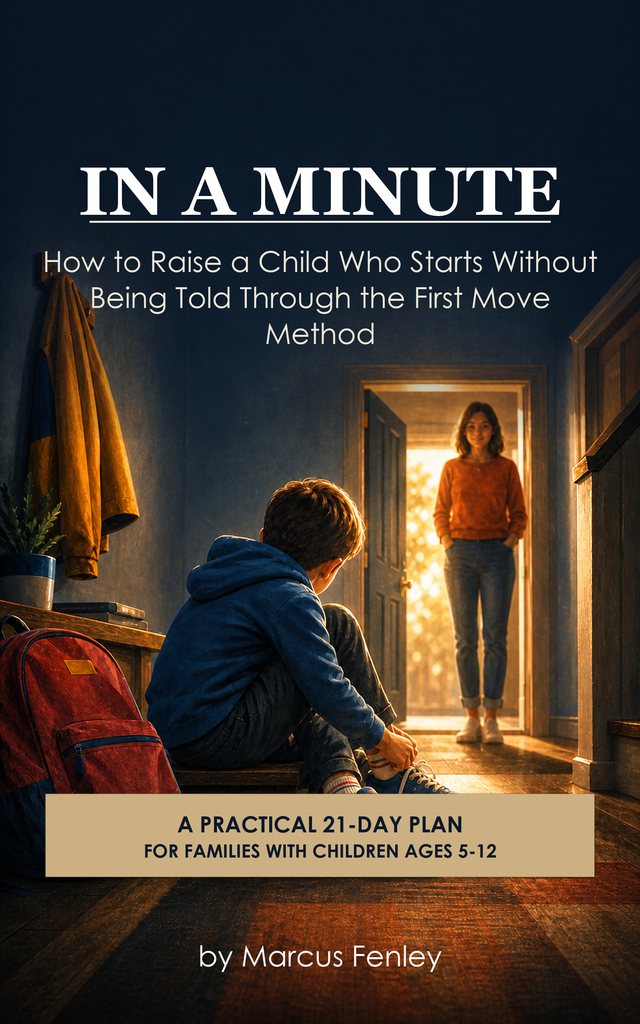
The Parent Leader Series · Book 2
How to Raise a Child Who Starts Without Being Told
Through the First Move Method
A practical guide to the reminder loop: how it develops, what different delays can mean, and how to help your child take more ownership of beginning.
From the introduction
“There is a sound every parent knows and almost nobody talks about. It is the sound of your own voice saying a thing you have already said, in a register you did not plan to use.”
Marcus Fenley · In a Minute
The book opens with the morning rush — and the distance between the parent you intended to be and the voice that came out.
Continue with the full bookInside the First Move Method
The method develops over five chapters. These three ideas introduce its approach.
Look for one physical action that starts the task, rather than presenting the whole job at once.
Help your child understand what “done” looks like, instead of leaving the task open-ended.
Explore reducing your role in stages, with guidance for moments when starting is still difficult.
The full book also covers “Say It Once,” practice over twenty-one days, and adapting the approach at five, nine, and twelve.
A look inside
Four parts, 17 chapters, followed by a closing word, scripts, quick reference, and glossary.
Is this your next read?
Written primarily for parents of children ages 5–12 who recognize the cycle of asking, waiting, reminding, and eventually raising their voice.
The book begins with observing your household, then works through the different delays before introducing the method. It is designed to be read in order first and returned to during practice.
The final chapter explores when a delay may call for professional assessment or additional support. The book is general guidance, not a clinical treatment.
Take the next step
Explore the full First Move Method in the edition that suits you.
Digital edition
Read on a Kindle device or in the Kindle app.
Buy Kindle on AmazonPrint edition
A print copy to read, mark up, and return to.
Buy Paperback on AmazonPrint edition
A hardcover edition for your bookshelf.
Buy Hardcover on AmazonEach button opens Amazon.com in a new tab. Check Amazon for current pricing, availability, and delivery details. Purchases are completed on Amazon.
Before you choose
No. The book distinguishes five patterns and encourages you to observe before choosing a response. A child can show more than one pattern in different situations.
It is one part of a larger method. The surrounding chapters address making the first move manageable, clarifying the finish, handing over gradually, and responding when your child still does not start.
No. The book includes a twenty-one-day practice chapter, but it does not make every child or household the same. The page presents it as a structure for practice, not a promise of results by a deadline.
Chapter 17 addresses that question. If you are concerned about attention, development, learning, or wellbeing, the book recommends speaking with your family doctor or your child’s school.
The digital edition is available on Amazon as a Kindle book. This website does not currently sell or provide PDF or EPUB downloads.
A smaller first move.
A place to begin together.