Instead of
“Why didn’t you tell me you were struggling?”

For the parent searching for the words
Make room for an answer. Start with a different sentence.
Conversation Scripts for Anxious Teens by Marcus Fenley offers practical words for the moments when you want to help but do not know what to say — with the reasoning behind each script, so you can make it sound like you.
Kindle · Paperback · Hardcover
Available on Amazon · For parents of teens ages 12–18

A familiar exchange
“How was school?” A shrug. “Is something wrong?” A one-word answer. You try again, and the conversation ends before you have learned anything.
The book begins with a different question: what makes talking feel possible in the first place?
Timing, pressure, and what happens after a disclosure all matter in the author’s approach. Before offering more questions, he looks at the conditions around the conversation — including the small relief of sitting side by side.
An actual script pair from the introduction
Instead of
“Why didn’t you tell me you were struggling?”
Try
“I think I’ve been missing something. Can you help me catch up?”
Marcus Fenley · Conversation Scripts for Anxious Teens
The first asks your teen to account for not telling you. The second acknowledges what you may have missed and asks for help understanding. The book explains the difference, then encourages you to use your own voice.
Read the reasoning behind the scriptsFor the moments you cannot rehearse
The scripts are organized around situations, so you can return to the chapter that fits the evening you are having.
Explore openers, one-word replies, and listening without immediately filling the silence or offering a solution.
Find examples for holding a boundary, handling disagreement, and starting a conversation you cannot keep avoiding.
Read about repair after shouting or a difficult exchange, including apologies that do not demand an immediate response.
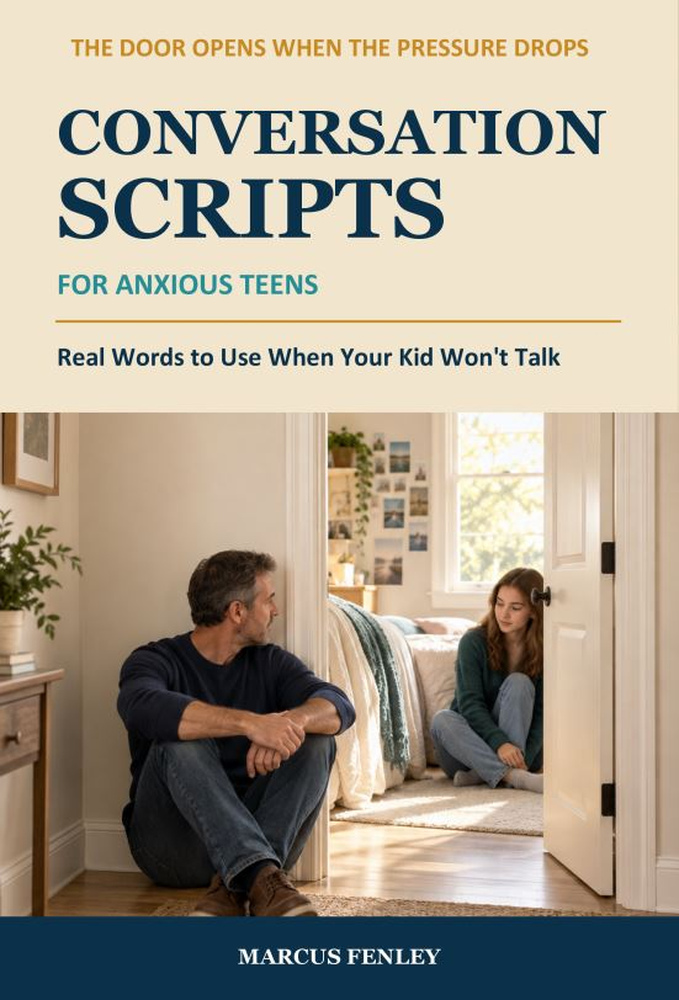
A practical conversation guide for parents
Real Words to Use When Your Kid Won’t Talk
A Parent’s Guide to Active Listening, Setting Boundaries, and Rebuilding the Parent–Child Relationship
The opening idea
The introduction explores why an ordinary side-by-side moment can feel different from a formal, face-to-face talk: less eye contact, somewhere else to look, and no announcement that a serious conversation is beginning.
That idea runs through the book. The words matter, but so do the circumstances in which your teenager hears them.
The aim is to keep a channel open. It is not to make your teen tell you everything, or to produce a perfect conversation every time.
A look inside
Four parts, twelve chapters, and a script index for returning to useful passages.
Is this your next read?
Written for parents of roughly twelve- to eighteen-year-olds when talking has become difficult and anxiety is part of the picture.
You can read the foundations first, then return to the scripts for silence, worry, boundaries, or repair. The practice plan offers a sequence of small actions, rather than a promise that your relationship will change in fourteen days.
This is an everyday conversation guide, not therapy or a substitute for professional care. Chapter 10 discusses when a conversation is not enough.
Take the next step
Read the scripts, the reasoning, and the complete conversations in the edition that suits you.
Digital edition
Read on a Kindle device or in the Kindle app.
Buy Kindle on AmazonPrint edition
A print copy to read, mark up, and return to.
Buy Paperback on AmazonPrint edition
A hardcover edition for your bookshelf.
Buy Hardcover on AmazonEach button opens Amazon.com in a new tab. Check Amazon for current pricing, availability, and delivery details. Purchases are completed on Amazon.
Before you choose
No. The introduction encourages you to understand the shape of a sentence and use your own words and register. The explanations are there to help you adapt it.
The book does not promise a disclosure every time. It includes a conversation that ends with the teenager declining to talk, and looks at keeping the relationship open even when you do not get an answer.
Yes. There are chapters on listening, anxiety-related exchanges, boundaries, conversations parents need to initiate, and repair after things go badly.
No. It is a way to practice small changes, one at a time. The book measures progress in the quality of contact, rather than how much a teenager reveals on demand.
No. It is a practical parenting guide to everyday conversation. It does not replace assessment or treatment by a qualified professional.
The digital edition is available on Amazon as a Kindle book. This website does not currently provide PDF or EPUB downloads.
You do not need a perfect speech.
You need a place to begin.