Lower your voice.
Notice the volume of your next sentence. Begin by bringing it down.

For the parent at the end of a long day
How do you stop this becoming another argument?
Before You Answer by Marcus Fenley explores what you can do in the brief moment before you respond — and how to come back when the words have already come out.
Kindle · Paperback · Hardcover
Available on Amazon · For parents of children ages 2–12

A familiar evening
Dinner needs finishing. The jacket is still there. You’ve already asked nicely, and now you can hear your voice getting louder.
Later, you know exactly what you wish you’d said. In the moment, finding those words is much harder.
Before You Answer starts in that gap. The book offers specific things to practice with your voice, your pace, and your response, even while you still feel frustrated.
One place to begin
One of the book’s ten rules gives you three small adjustments to practice in your next difficult conversation.
Notice the volume of your next sentence. Begin by bringing it down.
Leave a little more space between the words instead of rushing into the next response.
Keep the immediate message short. The longer conversation can wait until you can both take part.
The full book explores how to use these adjustments alongside steady boundaries, pauses, and repair.
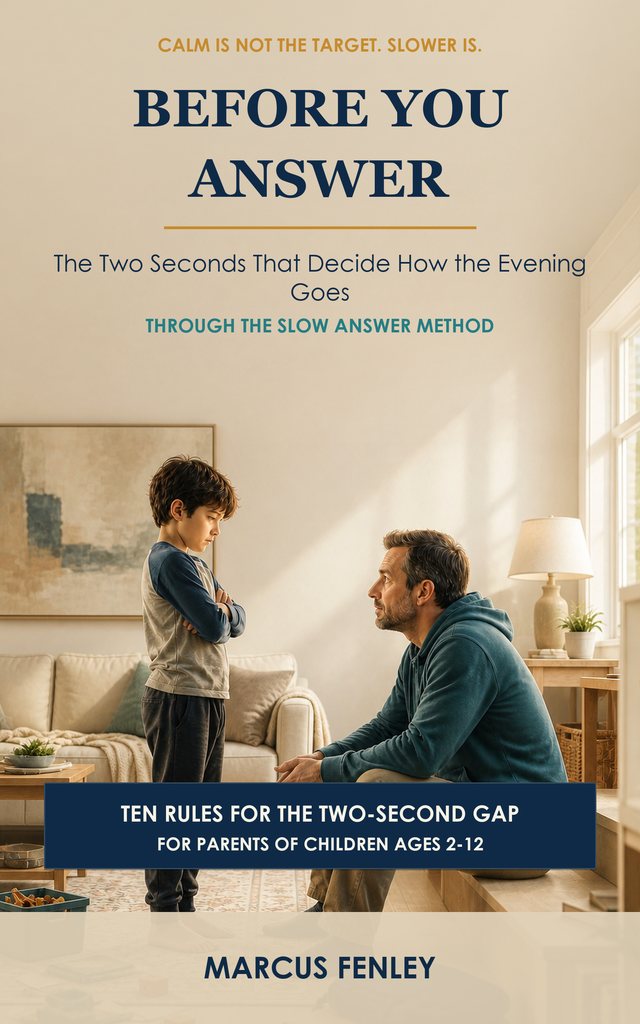
The Parent Leader Series · Book 3
The Two Seconds That Decide How the Evening Goes
Through the Slow Answer Method
Ten rules for the moments when parenting gets loud. Written around the everyday situations in which a parent’s intentions and response can pull in different directions.
From the introduction
“It was a Thursday and the dishwasher was halfway through its cycle, doing the loud part it does, and I remember that because I remember standing next to it while I said the sentence.”
Marcus Fenley · Before You Answer
The book begins with an ordinary evening and a response that comes out louder than intended.
Continue with the full bookA look inside
Four parts, followed by a conclusion, quick reference, and glossary.
Is this your next read?
This book is written for parents of children ages 2–12 who recognize the pattern of repeated requests, a raised voice, and regret afterward.
You can read it through, then return to the rules that fit your household. The quick reference brings the main ideas together for later use.
It is a practical parenting guide based on the author’s observations and experience. It is not a clinical treatment or a promise of a conflict-free home.
Take the next step
Get the full Slow Answer Method in the edition that suits you.
Digital edition
Read on a Kindle device or in the Kindle app.
Buy Kindle on AmazonPrint edition
A print copy to read, mark up, and return to.
Buy Paperback on AmazonPrint edition
A hardcover edition for your bookshelf.
Buy Hardcover on AmazonEach button opens Amazon.com in a new tab. Check Amazon for current pricing, availability, and delivery details. Purchases are completed on Amazon.
Before you choose
Its main focus is the parent’s response: what to do with your voice, your timing, and your actions. It also explores maintaining boundaries and returning to the conversation after an argument.
Part Three addresses what happens after things have gone wrong. It includes chapters on repair, repeated patterns, and parenting with another adult.
No. The introduction suggests reading the book in order once, then starting with the two rules that fit your household. You can return to the others when you need them.
The digital edition is currently sold through Amazon as a Kindle book. This website does not currently sell or provide PDF or EPUB downloads.
No. This is an educational parenting guide. It does not replace professional medical, psychological, or educational assessment. If you are concerned about your anger or your child, speak with a qualified professional.
A small place to begin.
A book to return to.